
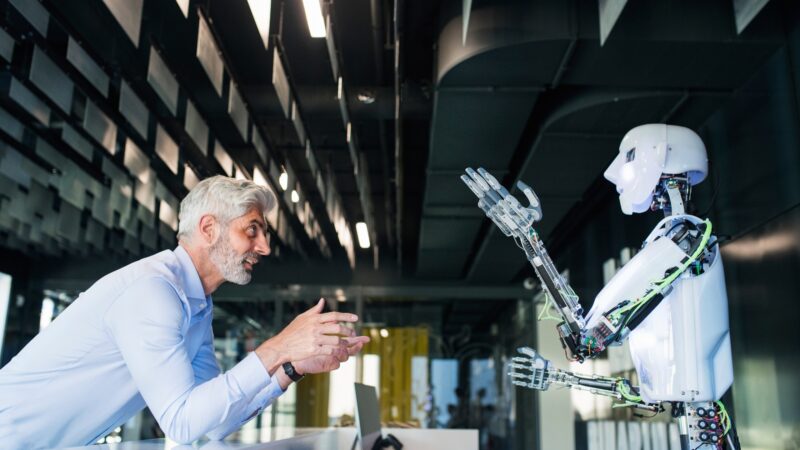
Human-robot interaction (HRI) has become the future of how work is perceived in organizations. Robotics and automation are now collaboratively working to provide humans with support and safety across businesses. Technologies like AI, ML, Big Data, human factors engineering and more are making it possible for humans to include them in the dynamic fields of engineering and change.
But why?
It is the capability of cooperation and collaboration that is essential for a successful incorporation of technology in a variety of industries and situations. Who’s capability? Robotic capabilities and human collaboration enhance their cooperation in working with one another and focusing on improving the situation of the market.
Let us dive into the details of how human-robot interaction is enhancing collaboration and what graduates can learn from this.
Ways in which Human-Robot Interaction is enhancing collaboration
- Real-time communications
Seemingly a bright future, AI and ML enhance HRI capabilities. Humans’ intentions and emotional capabilities are constantly being assessed by robots to improve their cognitive abilities. This enhances real-time communications, enabling robots to comprehend the surroundings and react to human actions. Further, this helps build a safer and more secure environment in industrial settings, enhancing productivity while maintaining a positive work environment for the organization.
- Shared workspaces
The integration of Internet of Things (IoT) technologies facilitates connectivity and coordination across multiple robots and automated systems. Collaborative Robots (Cobots) can safely work with humans sans any barriers. The setup of a shared workspace between robots and humans strengthens problem-solving capabilities, real-time cooperation, and the ability to perform tasks with precision and endurance. Cobots can significantly reduce the physical stress of workers in the industries by handling repetitive and strenuous tasks. This boosts the security of the workers, improves satisfaction, and reduces the risks of injuries among them.
- Task allocations and coordination
Cobots with HRI technology are highly flexible and can be frequently programmed to perform different tasks. The adaptability of resources and other tasks can be used to do a quality inspection without the need for significant reassurance or reconfiguration. Intelligent robots can easily analyze workflow situations and take into account the capabilities and conditions of both workers and the robots. The processing and creation of natural language, the understanding of non-verbal cues, and the ability to adapt to human styles are all talents that robots should have within their capabilities.
- Safety to enhance collaboration
Why is safety so important? Well, a few powerful robotic movements can cause hazards to even humans who have designed them. However, when it comes to Cobots, their speed is equivalent to that of human beings, which limits their possibility of creating a hazard in the environment or questioning the safety of human workers.
By taking on dangerous tasks like loading and unloading, stacking, packing and more, organizations can minimize workplace incidents. Cobot movements can be easily assessed, allowing nearby operators in the industries to avoid any unintended contact with them. You can read the ISO 10218 standard to understand how safety can be assured in different situations.
- Learning and skill adaptation
Human-robot skills can be improved through adaptable and sensitive measures proposing HRI collaborations. Through machine learning algorithms, robots can improve their ability to adapt to human behavior and realize responsibilities in the field of interaction and research. Explicit AI is used to improve communications and tailor processes, responses, and content in the marketing industries. Voice commands, gesture-based controls, and other methods are being used to learn and develop an improved human-computer interaction.
- By understanding the basics of how robots work and learning to program them through AI algorithms, HRI can be facilitated to do wonders.
- For graduates, in pursuit of ESDST’s intellectual mission, the faculty members take the lead, guided by the principle of Minds in Motion. By going beyond the confines of conventional teaching methods, they transform classrooms into vibrant centres of knowledge, encouraging students to think critically and creatively and pushing the limits of what is possible.
- Acquire relevant skills by enrolling in exciting ESDST programs and gaining hands-on experience through internships and projects involving HRI technologies.
- Develop problem-solving and critical thinking capabilities to solve complex tasks and delegate them efficiently. Entrepreneurs can find new ways to improve workflows and enhance collaboration between humans and robots. This is best utilized by identifying gaps in the market and creating startups to offer innovative HRI solutions.
- Being a professional, you can offer consulting services to help businesses utilize HRI processes effectively.
- Partner with technology gap providers, research institutions and more to play in the market and build a robust ecosystem involving Cobots.
- Support incubators and accelerators are continuously being developed to focus on robotics and automation startups.
Collaborative efforts to leverage the unique strengths of HRI
- Graduates, professionals, and entrepreneurs can take the initiative together to join interdisciplinary projects and tackle complex problems in the HRI to ensure the safety of the workplace and the workers.
- Through knowledge-sharing platforms and online communities, continuously develop new HRI solutions that can help interact more naturally with humans.
- Connect with experts through social media and attend events to interact with other people who might be at the forefront of AI and robots.
Delving further into the intricacies of cognition reveals an astounding finding: our visual recognition abilities outstrip our verbal expression abilities. Gestures take centre stage as the principal form of non-verbal communication, which brings the phenomena to life. Not only may gestures convey ideas more simply than words alone, but they can also abstract ideas against one another.
The potential for human and robot cooperation will grow in tandem with the rate of technical development. Advancements in fields like advanced robotics, augmented reality (AR), and brain-computer interfaces (BCIs) are paving the way for more sophisticated HRI. With the help of HRI, a future where people and robots collaborate more efficiently is just around the corner. In many fields, this will pave the way for exciting new possibilities in terms of innovation, productivity, and safety.
Finally, Human-Robot Interaction (HRI) is crucial to the effective incorporation of robots into corporate settings since it promotes teamwork and security. Businesses may harness the power of robotics, promote harmony between humans and machines, and boost productivity by emphasizing intuitive design, enhanced perception, efficient communication, rigorous safety measures, and constant learning.